



Why Simcenter MAGNET ?
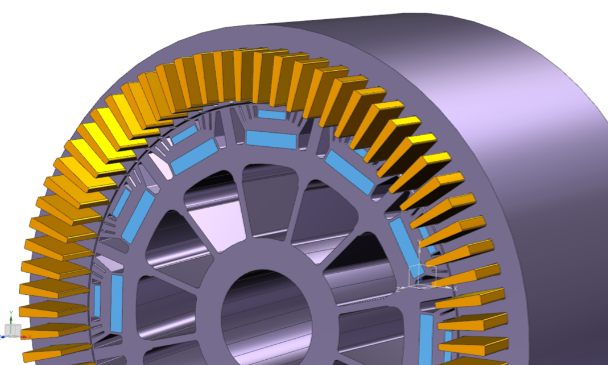
Simcenter MAGNET is a powerful electromagnetic field simulation solution for performance prediction of motors, generators, sensors, transformers, actuators, solenoids or any component with permanent magnets or coils.
Model the physics of electromagnetic devices
Simcenter MAGNET includes capabilities to accurately model the physics of electromagnetic devices. This includes the ability to model manufacturing processes, temperature dependent material properties, magnetization and de-magnetization modeling, and vector hysteresis models among others.
Simcenter MAGNET also has a built-in motion solver with a six degree-of-freedom capability. It allows for complex problems like magnetic levitation or complex motion to be accurately modeled and analyzed. This is made possible with a unique smart re-meshing technology.
Explore the possibilities through simulation automation
An efficient design process requires tools which can be customized to the workflow. Simcenter MAGNET includes sophisticated scripting capabilities that allow for flexible workflow automation.
Using the Simcenter MAGNET fully parameterized CAD functionality will improve the efficiency of your simulation. In particular, models that would ordinarily require a lot of manual processes, such as those that include numerous calculations for various magnets with different dimensions and many air gaps.
Stay integrated with circuit to system level modeling
System-level (1D) or model-based (2D axisymmetric, 2D translational, and full 3D) analysis requires accurate sub-component models to account for interactions and local transients that affect the overall system behavior.
Simcenter MAGNET includes capabilities such as native circuit simulations, connections for co-simulation and exporting of 1D system models for Simcenter Flomaster, Simcenter Amesim and other platforms.
Capabilities
AC electromagnetic simulation: simulates electromagnetic fields in and around current-carrying conductors, in the presence of isotropic materials that may be conducting, magnetic or both.
Advanced electromagnetic material modeling: acounts for nonlinearities, temperature dependencies, demagnetization of permanent magnets, hysteresis loss and anisotropic effects.
Electric field simulations: simulates static electric fields, AC electric fields and transient electric fields.
Electromagnetic-motion simulation: simulates rotational, linear and arbitrary motion with six degrees of freedom.
Transient electromagnetic simulation: permits the simulation of complex problems that involve time-varying arbitrary-shaped current or voltage sources and outputs.
Steady-state and transient temperature distribution: considering losses in the winding as well as core, including the eddy current and hysteresis losses.
Benefits
Enable low- and high-frequency electromagnetics simulation in a multidiscipline integrated environment
Manage and simulate multiscale models of the highest complexity in a reasonable amout of time
Use advanced algorithms to enhance readily available material data for high-fidelity simulations
Use integrated EM-thermal solvers to predict permanent magnets’ demagnetization and hot spots for increased robustness